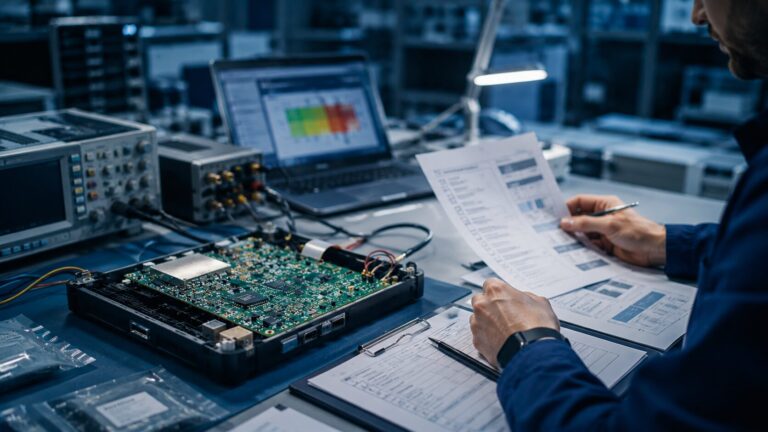
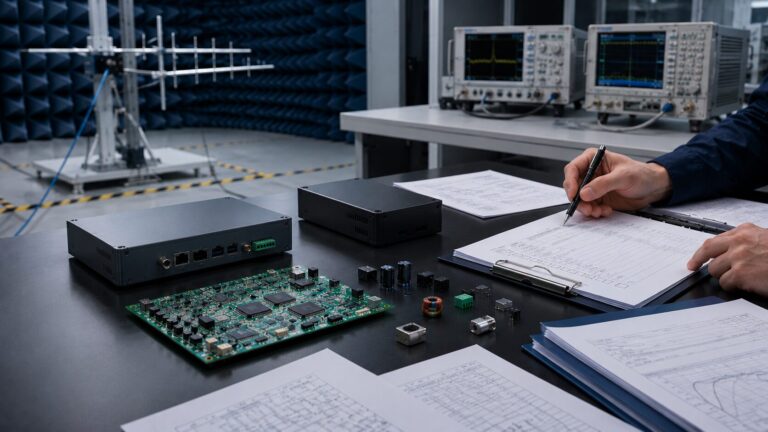
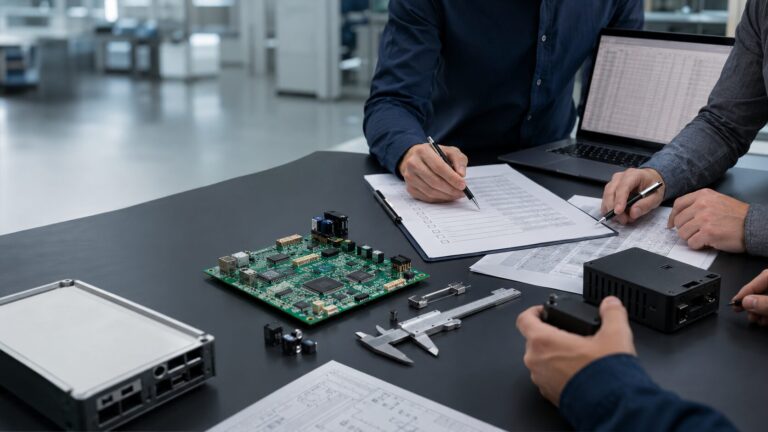
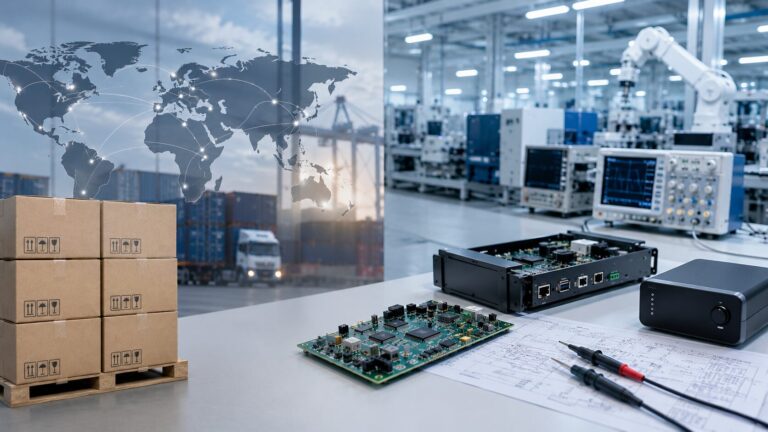
From Idea to Electronic Device
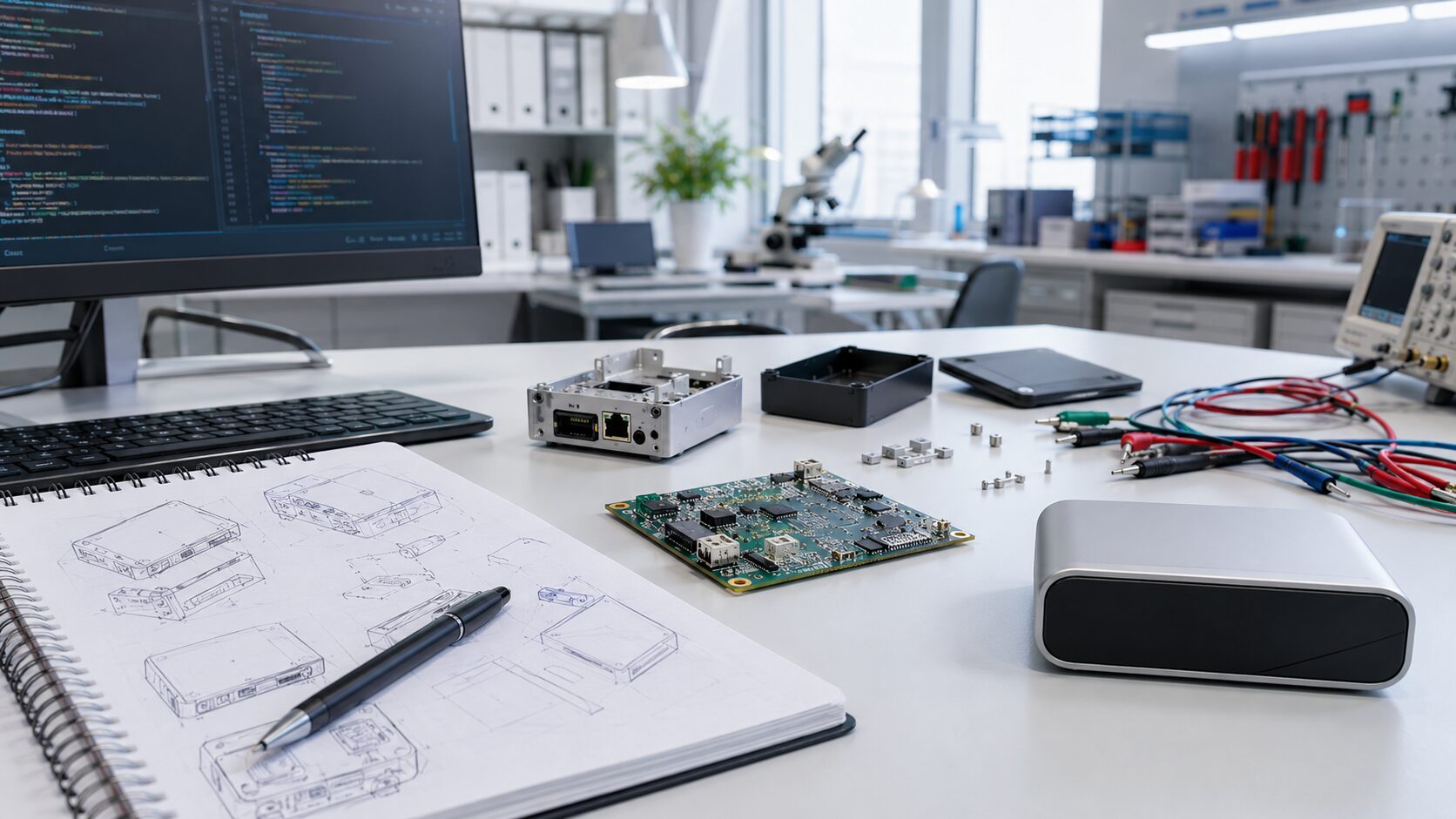
Do you have an idea for an electronic device, a prototype from initial testing, or a product that needs to be prepared for mass production? You understand the problem the device should solve, you know the market and the customer, but a practical question arises: who can help you transition from concept to a functional, repeatedly producible product?
This is often the point at which many clients begin searching for an “electronics partner.” However, it quickly becomes apparent that the market uses a variety of terms: electronics design, PCB, prototyping, EMS, contract manufacturing, NPI, DFM, testing, final assembly, and box build. For a client simply looking to develop and manufacture a device, this terminology can be unnecessarily complex.
This article outlines the process from initial concept to finished electronic device, highlighting common risk areas, the information needed before engaging with a potential partner, and when it’s beneficial to seek out a team that integrates design and electronics manufacturing.
This article is intended for:
This material is intended for clients seeking a partner for a broader range of services beyond PCB assembly.
Typical Applications:
- You have an idea for a new device and need to assess its feasibility?
- You have a prototype, but you’re unsure if it can be manufactured repeatedly.
- You have an electronics project, but lack the necessary production documentation and testing procedures?
- Do you have a product currently manufactured manually or in small batches, and you’re looking to scale up to mass production?
- Are you experiencing issues with your current supplier and seeking to streamline your project?
- Do you want to consolidate your design and production processes with a single partner?
- We provide support for electronics design, enclosure development, testing, and production preparation.
If you recognize any of these scenarios, the cost of PCB assembly alone may be a limiting factor. First, it’s necessary to determine precisely what needs to be designed, verified, tested, and prepared for production.
What is your starting point, and what are the next steps?
| Getting Started | The next logical step | The primary risk associated with overlooking this |
|---|---|---|
| Do you have an idea for a device? | Specify the application, technical requirements, and limitations | Electronic device design begins with initial specifications, which may later prove to be incorrect |
| Do you have a prototype electronic device? | Verify manufacturability, testability, documentation, and compliance | The prototype will function individually, but will not reliably transition to mass production |
| Do you have a project and require manufacturing services? | Verify the Bill of Materials (BOM), production files, test procedures, enclosure specifications, and quality criteria | Contract electronics manufacturing can begin with gaps that will increase costs and the rate of defects |
Three common starting points:
Clients approach us with varying levels of project readiness. This is important because the initial stage of a project determines the scope of work, pricing structure, and technical risks involved.
You have an idea, but not a design?
This is the initial stage. The client knows the problem they want to solve, but they may not yet have a schematic, PCB layout, bill of materials, or prototype. Often, only a functional description, a housing sketch, client requirements, or a reference device exists.
In such cases, the initial step is not production, but rather a thorough analysis of needs, requirements, and feasibility. This involves defining the product’s intended application, target market, end-user, operating environment, power supply method, expected lifespan, service model, and production scale.
This information defines specific technical and regulatory requirements. The design approach differs significantly depending on the application, whether it’s a consumer device, an industrial telemetry module, a household appliance controller, or a product operating in harsh environmental conditions. It’s crucial to identify relevant standards, safety requirements, electromagnetic compatibility (EMC) regulations, radio communication protocols, or labeling requirements from the outset.
Without such analysis, a product may function technically but fail to meet market requirements, standards, or user expectations. This can lead to problems later in component costs, PCB modifications, enclosure design, testing, or production implementation.
The goal is to establish a clear direction: defining what we are designing, identifying constraints, and determining what needs to be validated through prototyping.
If a project is still in the conceptual phase, but the timeline or business risks are already critical, a preliminary qualification process is recommended. Inventronics conducts such assessments as part of product development and through the Rescue NPI 60 implementation support program. Rescue NPI 60
You have a prototype, but not a production-ready product.
A common scenario: the prototype functions, but it was built quickly, often manually or using readily available components at the time. While it serves a demonstration purpose, its suitability for mass production remains uncertain.
It’s easy to develop a false sense of security at this stage. While a working prototype demonstrates the feasibility of an idea, it doesn’t guarantee that the product can be manufactured repeatedly, tested, certified, and maintained.
At this stage, it is necessary to verify not only the device’s functionality but also its technological aspects: the PCB design’s resilience to production variations, enclosure compatibility, firmware programming methods, the availability of test points, the ability to detect critical errors before shipment, and compliance with relevant standards.
A prototype review should encompass four key areas: manufacturing, testing, compliance, and documentation. Only after such a comprehensive review can one determine whether process refinement is sufficient or if a design change is necessary.
Many elements often remain to be addressed before a solution is finalized, including production tooling, testers, adapters, programming procedures, quality control stations, assembly documentation, BOM variations, batch traceability, and acceptance criteria for the first production run.
The primary objective is to differentiate between functionalities proven in the prototype phase and those ready for repeatable production.
If a prototype is stuck between demonstration and implementation, a useful first step is an intervention assessment: a risk map, a 30/60/90 plan, and a decision on whether the project has a viable path to New Product Introduction (NPI), pilot production, or full-scale production. The following describes the scope of the Rescue NPI 60 service: Rescue NPI 60
You have a project, but need to streamline production.
The third scenario involves clients who possess documentation but experience difficulties with production, including high costs or reliance on numerous subcontractors. Challenges may arise from quality issues, component availability, inadequate testing, lengthy lead times, or a lack of comprehensive control over design changes.
Often, these issues stem from problems encountered in earlier stages. While a prototype may function correctly in a designer’s office, production launch can reveal technological, quality, or compliance challenges. This typically occurs when a design is developed without considering Design for Manufacturing (DFM), Design for Test (DFT), and Design for Assembly (DFA) principles.
In such projects, assembly times often exceed initial estimates, leading to increased labor costs, a higher incidence of defects, and difficulties in conducting testing. Furthermore, responsibility for quality becomes blurred between the design and production phases.
That’s why it’s worth considering a single-source design and manufacturing model. When the same entity assists with design, prepares the product for production, and then manufactures it, it’s easier to maintain consistency in technical decisions related to assembly, testing, costs, quality, and repeatability.
The process begins with a project and process audit. The partner should review the documentation, bill of materials, manufacturing files, test procedures, and historical issue logs. Only then can a decision be made regarding whether process improvements are sufficient or if design modifications are necessary.
This scenario is particularly important when transferring production or scaling up from small production runs to larger volumes.
If production has already begun but is experiencing delays, quality issues, supplier disputes, or compliance problems, this is a typical scenario for NPI intervention. In this mode, we first organize the input data, assess risks, review documentation, and develop a project stabilization plan. Rescue NPI 60
Why simply “manufacturing the PCB” is often insufficient.
In electronic devices, the PCB is a crucial component, but it rarely represents the entire product. A finished device typically includes firmware, power supply, sensors, communication modules, enclosure, wiring harnesses, connectors, labels, testing procedures, instructions, and quality requirements.
Therefore, the question “how much does it cost to produce a PCB?” often arises prematurely. More appropriate questions are:
- Is the project ready for production?
- Is the documentation complete?
- Can components be purchased directly?
- Does the product have scheduled testing?
- Is there a known method for detecting errors before shipment to the customer?
- Are the enclosure, mechanics, and electronics integrated and compatible?
- Can the same quality level be consistently maintained across subsequent production batches?
Companies that overlook these questions often save time initially, but frequently lose it later: in PCB revisions, component changes, final testing, warranty claims, or production ramp-up issues.
Below is a simplified, 7-step overview of our process. The detailed Inventronics process encompasses 16 stages: from system design and electronics development, through firmware, prototyping, certification, and production preparation, to mass production, logistics, and support. Inventronics product development process.
Phase 1: Defining product needs and requirements.
A successful product design doesn’t begin with a schematic. It starts with understanding the product’s intended function, the operating environment, and the value it will provide to the user.
At this stage, it is important to gather essential information:
- What functionalities should the device possess?
- who will be the end user,
- In what environment will the product operate?
- What are the dimensional, power, and cost limitations?
- Does the product require connectivity?
- Do you require a firmware update?
- Which standards, certifications, or customer requirements may be relevant?
- What is the anticipated production volume?
The more detailed the description of the problem and application, the easier it is for our design partners to select the optimal solution. Complete technical documentation is not always required. Initially, a clear description of the objective, operating conditions, and business expectations is sufficient.
Phase 2: Technical Concept and Device Architecture.
Once the requirements are finalized, we proceed to the technical design phase. This stage involves critical decisions that impact cost, lead time, risk, and subsequent production.
Typical decisions include:
- selection of key functional modules,
- selection of microcontrollers, communication modules, and sensors.
- Power supply method:
- Firmware specifications:
- method of updating and diagnostics,
- Preliminary selection of enclosure or mechanical requirements.
- testing strategy,
- Batch and product version traceability level.
This stage is crucial because architectural modifications are inexpensive as long as they remain theoretical. Once the PCB, enclosures, and prototypes are manufactured, each subsequent change becomes significantly more costly.
In practice, a good partner should be able to say not only “it’s possible,” but also “it’s possible, but it will increase testing costs,” “this component has a risk of availability,” “this enclosure will complicate assembly,” or “this interface requires additional validation.
Phase 3: Electronics design, PCB layout, and documentation.
Once a concept is approved, the actual electronics design phase begins. This includes schematic design, component selection, PCB layout, mechanical constraint analysis, and the preparation of documentation required for prototype fabrication.
At this stage, the following are produced, among other things:
- electrical schematic,
- Component list.
- PCB design,
- production files,
- Assembly requirements:
- Preliminary test documentation.
- Data required for component procurement.
From the outset, design should consider not only functionality but also manufacturability and testing. This includes incorporating space for test points, ensuring component availability, planning firmware programming procedures, enabling optical inspection, and accounting for assembly limitations.
When a design is created without considering manufacturing, problems often arise later: insufficient clearances, difficult access to test points, components that are unavailable for purchase, unclear Bill of Materials (BOM) variations, or a lack of clear assembly instructions.
Phase 4: Prototype and Initial Validation.
The prototype is not yet a product ready for sale. It is a tool for validating design assumptions.
In the prototype phase, we verify:
- Does the electronics meet the specified requirements?
- Does the firmware communicate correctly with the hardware?
- Is the power supply stable?
- Does the device fit within the enclosure?
- Are the primary functions testable?
- Are there any potential thermal, mechanical, or communication issues?
- Verify that the component costs align with the initial projections.
At this stage, revisions are natural. This is not a project failure, but rather a part of the process. It is important that all revisions are documented, and that decisions have clear ownership. Otherwise, it is easy to lose track of the reasons behind a particular change and its impact on the product.
A well-executed prototype should lead to clear decisions regarding what needs improvement, what can remain as is, what requires further testing, and what is ready to proceed to the next stage.
Phase 5: Preparation for Mass Production.
Transitioning from prototype to mass production is a distinct phase. In the industry, this is often referred to as NPI, or New Product Introduction. However, what matters most to the client is the outcome: ensuring the product can be repeatedly manufactured, tested, and delivered.
At this stage, it is necessary to organize:
- the final list of components,
- Product variants:
- assembly documentation,
- firmware programming procedures,
- testing procedures,
- Quality acceptance criteria.
- Packaging method:
- Batch traceability and serial number identification.
- post-production change management.
Here, the distinction between a prototype and a finalized product often becomes apparent. While a prototype may function, production demands repeatability. If each unit requires manual adjustments, additional interpretation, or engineering decisions, the process is not yet ready for scaling.
Step 6: Integration into the final device.
A populated PCB is often just one component of the final product. It typically requires integration with enclosures, wiring harnesses, connectors, mechanical components, software, labeling, final testing, and packaging.
In the industry, this process is often referred to as final assembly or box build. The client does not need to understand these terms. What is important is that someone takes responsibility for integrating the electronics with the rest of the device.
This stage may include:
- PCB assembly in enclosures.
- connection to harnesses and connectors,
- Assembly of mechanical components,
- programming or configuration of the device.
- Final testing.
- visual inspection,
- labeling,
- Packaging.
- Preparing for shipment.
If the client requires a complete device, rather than just a printed circuit board, this aspect must be planned in advance. Otherwise, the final assembly process becomes a series of improvisations.
Phase 7: Testing and Quality Control.
Testing is not an afterthought; it is an integral part of the product development process.
It is essential to define what will be tested, how frequently, using which tools, and according to what criteria. Testing procedures differ for prototype testing, initial production run testing, and final inspection before shipment.
The testing strategy may include:
- optical inspection of assembly processes,
- electrical testing,
- functional testing,
- firmware programming and verification.
- Communication test.
- Power supply test.
- configuration control,
- Final testing of the finished device.
The most crucial question is: what defects must be detected before shipment to the customer? The answer to this question determines the testing procedure.
Without testing, production may appear satisfactory on the surface. However, problems often manifest only at the customer’s end, where the cost of repair is significantly higher than the cost of identifying the error during the manufacturing process.
What do production and testing technologies entail?
In practice, the production of electronic devices may involve SMT assembly for surface-mount components, THT assembly for selected connectors or through-hole components, AOI inspection, ICT testing, FCT testing, and final device testing. Clients do not need to understand the details of each technology. It is important that the partner can select the appropriate scope of production and quality control based on the product’s risk profile, volume, industry requirements, and the potential consequences of failure.
How do the 7 steps outlined in the article map to the Inventronics process?
On the Inventronics website, the product development process is described in 16 stages. In this article, we consolidate these into 7 broader blocks, as clients typically do not require a complete operational overview at the outset. Instead, they need to understand the current status of their project and the next logical step.
| Overview in this article | Corresponding Inventronics process stages |
|---|---|
| Phase 1: Defining product needs and requirements | 01: System Design; 02: Industrial Design; partially 09: Certifications |
| Phase 2: Technical Concept and Device Architecture | 01: System Design; 03: Mechanical Engineering; 04: Electronics Engineering; 05: Firmware Development |
| Phase 3: Electronics design, PCB layout, and documentation | 04: Electronic Engineering; 05: Firmware Development; partially 07: Fixture Design |
| Phase 4: Prototype and Initial Validation | 06: Prototyping; 08: Golden Sample; 09: Certifications |
| Phase 5: Preparation for Mass Production | 10: Production preparation; 11: Pilot production |
| Step 6: Integration into the final device | 7. Fixture design and fabrication; 10. Production preparation; 11. Pilot production; 12. Mass production |
| Phase 7: Testing and Quality Control | 06: Prototyping; 08: Golden Sample; 09: Certifications; 10: Production Preparation; 11: Pilot Production; 12: Mass Production |
Further stages, such as logistics, warehousing, distribution, and after-sales support, are particularly important when the device is to be produced in cycles or requires servicing.
You can find the complete list of stages here: Inventronics product development process.
What are the most common risks that prevent a project from moving to production?
Often, it’s not a single major issue that causes problems, but rather the accumulation of minor deficiencies.
Typical Risks:
- incomplete project documentation,
- List of components without suggested alternatives.
- Components that are difficult to obtain or pose a procurement risk.
- No test procedure available.
- No test points are available on the PCB.
- The enclosure is not compatible with the electronics.
- Firmware not yet prepared for production programming.
- Lack of version traceability.
- Changes implemented without a decision history.
- Unclear division of responsibility between project management, procurement, production, and quality control.
These issues can be minimized if a design and manufacturing partner is involved early in the process. The later the manufacturing team sees the design, the less opportunity there is to make improvements without incurring costly changes.
When is it beneficial to seek a single partner for project and production?
Not every project requires a single partner for the entire process. However, when a product is intended for mass production, a single design and manufacturing partner can minimize handoffs, misunderstandings, and gaps in responsibility.
This is particularly important when:
- The product is new and requires further technical refinement.
- The project will be developed iteratively.
- The electronics must be compatible with the enclosure and mechanical design.
- Final testing is required.
- The product features firmware or communication capabilities.
- Traceability of versions and batches is crucial.
- Repeat production is planned.
- The client seeks to minimize risk during the transition from prototype to mass production.
Having a single partner doesn’t automatically guarantee simplicity. However, it does mean that design, testing, and production can be planned as a unified process, rather than as separate stages passed between different companies.
What should be the outcome of the initial phase?
The initial technical discussion doesn’t always result in a complete offer for mass production. Often, it’s premature to do so. If the project details are not yet fully defined, a roadmap outlining the next steps is a more honest and valuable outcome for the first phase.
This map should answer the following questions:
- What is the current status of the product?
- Identify what is missing for prototyping or production.
- Which areas pose the greatest risk?
- What decisions need to be made before obtaining a quotation?
- What documents are required?
- What can be done in parallel?
- What is the most logical and efficient next step?
For our clients, this is crucial because it avoids seemingly attractive but inaccurate pricing. If the scope of work is unclear, the price will also be uncertain. In practice, it’s better to start with a brief analysis phase rather than later incurring costs for revisions resulting from incorrect assumptions.
The initial phase may result in a technical concept, a risk assessment, a prototype scope definition, a preliminary architecture, a list of required data, or a project readiness plan for production.
When is a project ready for a meaningful quotation?
Customers frequently require a quick understanding of the unit cost of a product. This is understandable, as pricing information is essential for business decisions. However, providing an accurate price estimate requires a clearly defined scope of work.
The project can be accurately priced when the following information is available:
- What is the function of the device?
- What are the technical and environmental requirements?
- Which components are critical?
- Do you have an existing PCB design, or does it need to be developed?
- Do you require firmware?
- Does the product include a housing and mechanical components?
- What should the final testing process look like?
- What is the planned quantity?
- Whether the client requires a prototype, a pilot production run, or full-scale production.
Without this data, the offer will be based on assumptions. While this may be sufficient for an initial assessment, it is not adequate for responsible production planning.
Therefore, a reliable partner should clearly differentiate between three levels of pricing: an initial estimate, a project design quotation, and a production quotation following documentation finalization.
Minimum Technical Package Required Before Production.
Before a product enters production, it should have a defined technical package. This isn’t about bureaucracy; it’s about ensuring consistent manufacturing processes and enabling the identification and analysis of any errors.
The minimum package typically includes:
- current schematic or project description,
- PCB files and production data.
- a list of components with variations and alternatives,
- Firmware version description.
- programming or configuration instructions,
- Final test description.
- Quality acceptance criteria.
- assembly documentation,
- Housing and packaging requirements.
- Traceability guidelines for batch and version identification.
What is the process for transitioning from the initial production run to repeatable, high-volume manufacturing?
The initial production run serves not only to deliver the first units but also to validate the manufacturing process.
In the initial series, it is important to verify:
- Is the documentation clear and understandable for production purposes?
- Are the components arriving as planned?
- Does the assembly process require improvisation?
- Does the test detect the most critical errors?
- What is the programming and configuration time required?
- What challenges arise during enclosure design?
- Are the packaging and labeling processes consistent and standardized?
- What are the actual operating times?
Following the initial production run, a concise review should be conducted to identify what is functioning correctly, areas for improvement, necessary clarifications in the documentation, and changes to be implemented before the next production batch.
This is a crucial step that should not be skipped. Proceeding directly to large-scale production without validating the process can result in more costly and difficult-to-resolve errors.
How Inventronics Can Help.
Inventronics can support clients throughout the entire product lifecycle, from initial design to production. Our services include electronic device design, documentation preparation, prototyping, testing, New Product Introduction (NPI), and electronic device manufacturing in production runs.
The discussion may cover the following topics:
- analysis of an idea or an existing prototype,
- Electronic design or design support.
- component selection and documentation preparation.
- PCB preparation for assembly.
- Project review for manufacturability and testing.
- Prototype development and testing.
- NPI preparation,
- electronics assembly,
- Firmware programming or version control, if included in the scope of services.
- Production and final testing.
- integration of electronics with enclosures or modules.
- quality and production documentation,
- Traceability of batches, versions, and test results.
The greatest value is realized when Inventronics can become involved in a project before the documentation is finalized. This allows for easier design of a product that is not only functional, but also manufacturable, testable, and maintainable.
What to prepare for your first meeting.
You don’t need a complete project design. However, it’s beneficial to provide information that allows for a quick assessment of the scope and potential risks.
Before the consultation, it’s beneficial to gather five groups of information, aligning with the initial project analysis process used by Inventronics.
-
Description of the concept and applications.
Describe the product concept, its intended application, key features, and the problem it is designed to solve. It is important to specify the operating environment and highlight the most important features for the user. -
Technical and regulatory requirements.
Gather information regarding power supply, communication protocols, firmware, enclosure, dimensions, assembly, technical limitations, and required standards, certifications, or regulations. If the product is intended for a specific industry, it is advisable to identify relevant quality or regulatory requirements from the outset. -
Market, target user, and production scale.
Determine the intended end-user, the target market, and the anticipated production scale (prototypes, initial production run, or full-scale production). This information influences the selection of technical solutions, testing procedures, documentation requirements, and the overall production preparation process. -
Input materials, prototypes, and reference samples.
If you have sketches, photos, models, schematics, a bill of materials, an existing prototype, or examples of similar products, please provide them. These materials help us quickly understand your requirements and reduce the number of assumptions. -
Budget, timeline, and key risks.
Please provide an estimated budget, desired timeline, and any major concerns you may have, such as: cost, lead time, component availability, testing requirements, quality standards, certification needs, potential production transfer challenges, or issues with your current supplier.
What constitutes a successful sales conversation?
A successful sales conversation doesn’t begin with simply quoting a per-unit price. First, it’s crucial to determine whether the client requires design services, prototyping, production preparation, assembly, testing, or a more comprehensive support package from concept to series production.
In practice, the discussion should cover several key areas:
- What problem does this product solve?
- What is the current status of the documentation?
- what has already been tested,
- Which components are confirmed, and which are still under consideration?
- What is the planned production volume?
- What are the quality and delivery requirements?
- What the client chooses to entrust to the partner, and what remains within the client’s control.
This collaborative approach allows us to clearly define the project phases: analysis, design, prototyping, production preparation, initial production run, and ongoing production. This ensures that each decision has a specific objective, associated cost, and defined completion criteria.
How to identify a reliable partner.
A good partner doesn’t start with just the assembly price. They first inquire about the product, project stage, requirements, testing, and planned production scale.
Consider the following when evaluating a potential partner:
- We understand the difference between prototyping and mass production.
- Inquiries regarding testing procedures and quality criteria are welcome.
- It can identify risks within documentation.
- discusses component availability,
- We offer a structured New Product Introduction (NPI) process.
- It is compatible with various product versions.
- We understand the importance of firmware in manufacturing.
- It can integrate electronics with mechanics and final testing.
- It clearly defines the scope of services, outlining what is included and what is excluded.
If the conversation focuses solely on the unit price, without discussing testing, documentation, and risk assessment, it’s a warning sign. The unit price is important, but only after clearly defining the product specifications and quality control procedures.
Common customer mistakes at the project’s outset.
A common mistake is initiating discussions too late in the project lifecycle, after the design is “locked,” but before a production feasibility assessment has been conducted.
Other common errors include:
- Lack of a clear product application description.
- underestimating the importance of testing,
- Selecting components without verifying availability.
- Treating a prototype as a production-ready design.
- No firmware or update plan available.
- No decision has been made regarding responsibility for documentation.
- omitting enclosure and final assembly,
- No acceptance criteria were defined for the initial production run.
Frequently Asked Questions.
Yes. Initially, a clear description of the application, functions, limitations, and expected business outcomes is sufficient. Complete documentation is developed as the project progresses from the concept stage to prototyping and production.
Not always. While a prototype demonstrates the feasibility of a solution, production requires repeatability, testing, documentation, component availability, and defined quality criteria.
Ideally, this should be addressed before project freezing. At that stage, adjustments can still be made to the PCB, enclosure, testing procedures, component selection, and assembly methods, avoiding costly changes later on.
Yes, if it encompasses design, manufacturing, and testing capabilities. This integrated model minimizes responsibility gaps between design, documentation, procurement, assembly, and quality control.
A concise product description, outlining the stage of development, available materials, planned scale, timeline, and key risks, is essential. This information allows us to determine the appropriate next step, whether it be analysis, design, prototyping, New Product Introduction (NPI), or production preparation.
Summary:
The journey from initial concept to a finished electronic device involves more than just designing and assembling a circuit board. It’s a comprehensive process that integrates user requirements, electronics architecture, firmware, PCB design, component selection, enclosure design, testing, documentation, manufacturing, and quality control.
Integrating design and manufacturing considerations early in the process minimizes the risk of costly changes later on. A reliable partner will not only manufacture your device but also prepare it for repeatable production, testing, and future development.
If you have an idea, prototype, or product requiring preparation for mass production, begin with a technical consultation. Together, we can assess the project’s stage, identify potential risks, review documentation, and determine the most efficient path to a finished product.
Contact Inventronics to discuss the design and manufacturing of your electronic device. We will provide an initial process overview, covering everything from concept or prototype development, through design and testing, to series production.